 |
|
||||||||||||



 |
 |
 |
 |
|||
Assess Your Mental Readiness for Change |
 |
Assess Your Mental Readiness for Change |
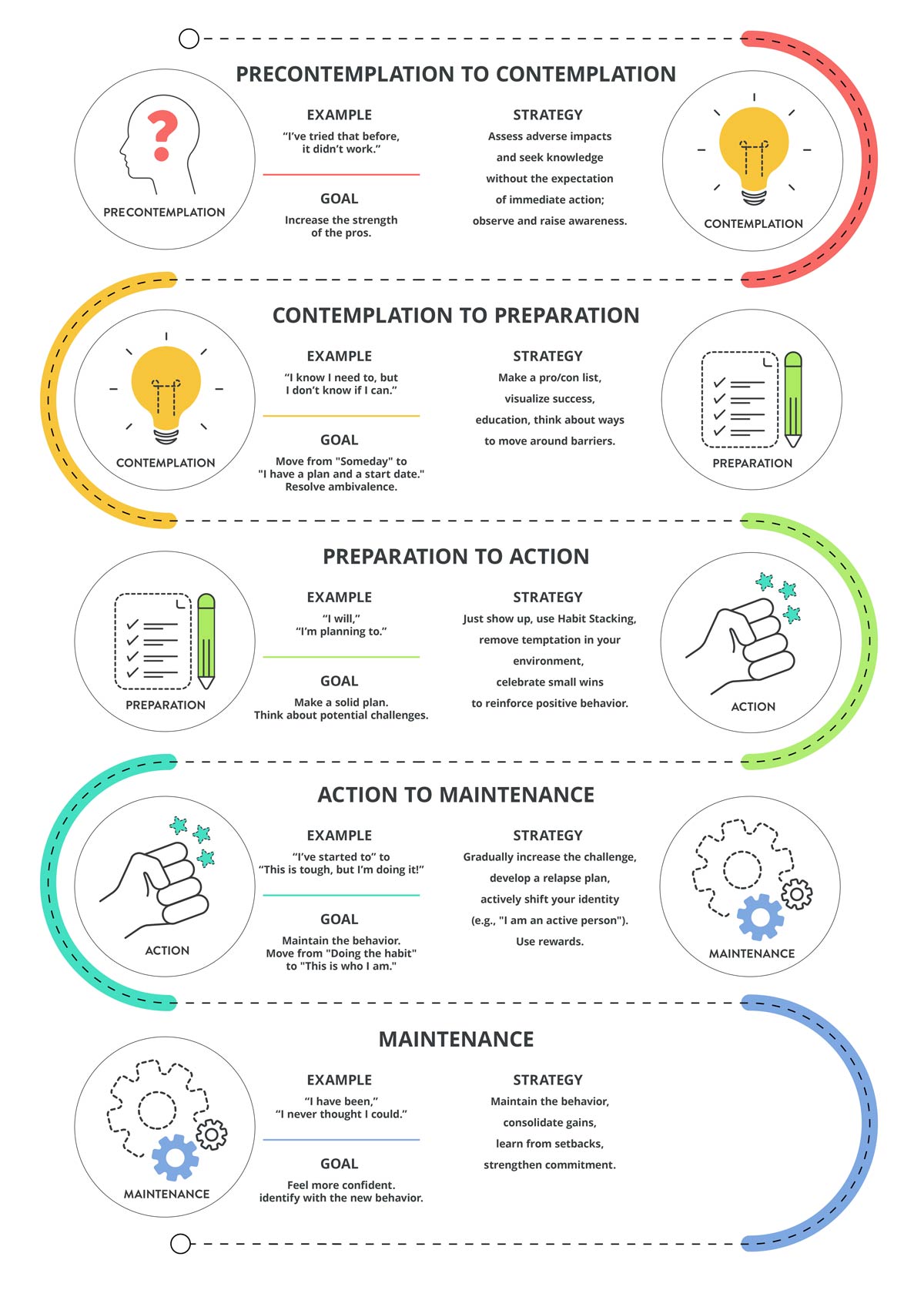
Most of us live our lives on autopilot. As creatures of habit, we tend to stick with our routines — even when they aren't serving us well — because they’re comfortable. That’s why making a change can feel like a struggle; it takes more than just willpower to switch gears. To avoid the “burnout” that comes from trying too hard, too fast, ensure you’re ready to make a change. If you’re considering — or actively trying — to make a change, it might help to understand how mentally ready you are for doing so. According to the Transtheoretical Model (TTM) of Change — a framework developed by James Prochaska and Carlo DiClemente to understand and guide behavior change — the first step is to commit only to what you are psychologically and emotionally ready to handle and then begin moving through each of the five stages of change to be successful. (see the diagram at the end of the article) Progressing Through the Stages of Change The five TTM stages are a blueprint for us to follow — Precontemplation, Contemplation, Preparation, Action and Maintenance (see sidebar, below). “We often blame ourselves when change doesn't stick, but the truth is, we usually have set a goal we weren't ready for yet,” says Hayley Flott, PDRMA Wellness Consultant. “Use this model as a guide to figure out exactly where you are today. It’s okay not to be ready for everything at once; the key is setting a goal you can reach right now. It builds momentum to keep you moving forward. When you know your current mindset, you can better choose the next steps to continue making progress.” Weighing Your Pros and Cons Before we make a change, our brains go through a mental tug-of-war called decisional balance. This is where you weigh the Pros of a change (your health, values and goals) against the Cons, such as the loss of the comfort of your current routine. If you feel indecisive, it’s likely because the Pro and Con scales are equal. You need to find a “why” powerful enough to tip that scale toward the Pro side. For example, making a change that might allow you to stop taking cholestorol medication could be the powerful "why" you need to tip the scale. That’s when making the change becomes more attractive than staying where you are. Mental Health and Pacing Setbacks can still occur, no matter how ready you might be, so prepare yourself for them. Remind yourself of the progress you’ve already made to know you can do it again. That way, you can reset and restart without any feelings of failure. Because when a challenge pops up, confidence in your ability to change is essential; belief in yourself matters. Be realistic about your expectations, though. You only have so much emotional bandwidth, and trying to do too much or go too fast can lead to burnout. It’s okay to step back one stage in the TTM model to catch your breath or rethink what’s most important to you. Change is not a straight line; it’s normal to move back and forth between stages. If you do move “backward,” use it as an opportunity to adjust your plan and start again; knowing what you’ve already done will help you move forward. PATH Resources PATH resources can make a big difference in preparing you for change. Consider the following to support your journey.
Actionable Strategies for Moving to Next Stages Consider using the strategies below for whichever TTM stage you find yourself in.
|