
Be Smart About “Fun in the Sun”
How Much Do You Know About Poison Ivy?
Poison ivy even has a superhero nemesis named after it, and the “Three Ps” — poison ivy, oak and sumac — can be as relentless as any comic book villain. Think you know everything you need to about these poisonous plants? Test your poison ivy IQ here.
More than 10 million people are exposed yearly to this adaptable shrub, which grows almost anywhere — as creeping ground cover, wrapped around tree trunks and as a standalone shrub. To make matters worse, its irritant oil, urushiol, is in every part of the plant from the roots to the leaves. And those leaves sometimes turn red in the fall at the same time that the plant can produce berries that last through the winter. Even worse, urushiol oil can remain active on tools, clothing and even animals — for up to five years!
To prevent exposure to any of the Three Ps, OSHA recommends wearing long-sleeved shirts and long pants tucked into boots as well as cloth or leather gloves and barrier creams on exposed skin. It’s also a good idea to keep rubbing alcohol handy, since it removes the oily resin as long as 30 minutes after exposure.
PDRMA Resources
|
As temperatures climb each summer, PDRMA members face two ongoing challenges: keeping employees safe when they're working outside during the hottest parts of the day and protecting patrons as well. From maintenance crews mowing fields to lifeguards monitoring crowded pools and camp counselors leading children through outdoor activities, sun exposure and heat-related illnesses are a constant threat.
According to PDRMA Risk Management Consultant Cheryl Morley, preparation and prevention are critical to reducing those dangers. “Although we often think people with the highest heat risk are the very old or young, or those with certain health conditions, the reality is quite different,” Morley says. “Exertional Heat Stroke can happen to young people without health problems if they work outdoors, engage in strenuous activity or wear heavy gear. Outdoor workers — especially lifeguards at pools — need to be aware of the risks and take preventive steps.”
That’s exactly how Channahon Park District manages summer safety. “Each day’s weather impacts both our day camp staff and program participants,” says Angela Brown, Director of Safety and Facilities, Channahon Park District. “This time of year, sun and heat are the biggest factors, and with our camp activities being mostly outside, those elements impact everyone in different ways. So each department addresses heat safety differently.”
For maintenance crews, the agency adjusts schedules and staffing whenever possible to avoid peak heat hours. Staff also has access to electrolyte drinks and lightweight sun-blocking shirts designed to provide protection without trapping heat.
Lifeguards face another level of exposure, because they spend long periods in direct sunlight while remaining intensely focused on swimmer safety. To help reduce fatigue and heat stress, Channahon Park District adds extra lifeguards for especially hot days to allow more frequent staff breaks. In addition to having drinks available, pool managers also have ice-cold towels to put on lifeguards’ backs to help cool them down, so they can stay focused on scanning the pool.
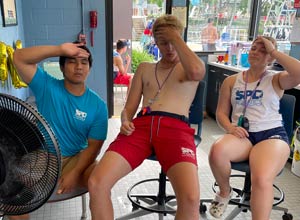 For day camp programs, prevention strategies focus on both staff and children. “We modify camp schedules during extreme heat, with counselors planning less strenuous activities during midday hours and adding indoor breaks whenever possible,” explains Brown. For day camp programs, prevention strategies focus on both staff and children. “We modify camp schedules during extreme heat, with counselors planning less strenuous activities during midday hours and adding indoor breaks whenever possible,” explains Brown.
Training plays a major role in keeping staff and patrons safe, not only at Channahon Park District but at Schaumburg Park District, too. “Our preparation typically begins with preseason training,” explains Alexandra Khodan, Manager of Aquatics and Safety, Schaumburg Park District. “We train our staff on weather awareness, heat-related illnesses, hydration and sun safety as part of onboarding and in-service programs. We also closely monitor weather forecasts, heat indexes and severe weather conditions throughout the season and adjust operations when necessary. And we continuously reinforce heat and weather safety during daily operations and trainings.”
The agency offers patrons shaded areas, hydration stations, sunscreen dispensers when possible and safety messaging. Lifeguards and staff also help identify patrons showing signs of heat-related illnesses. “Educating families on hydration, proper swim attire and taking cooling breaks can make a significant difference,” explains Khodan. She also notes that during high-heat days, proactive communication and visible reminders are key to keeping patrons safe.
 “One aspect that surprised many staff during training was how quickly heat-related illnesses can develop — even in young, healthy and active individuals,” adds Khodan. “Many people assume being around water prevents heat issues, but lifeguards can still become overheated very quickly in direct sunlight, so we encourage staff to speak up immediately if they feel unwell. We also stress that preventing heat illness is a team responsibility, not an individual one.” “One aspect that surprised many staff during training was how quickly heat-related illnesses can develop — even in young, healthy and active individuals,” adds Khodan. “Many people assume being around water prevents heat issues, but lifeguards can still become overheated very quickly in direct sunlight, so we encourage staff to speak up immediately if they feel unwell. We also stress that preventing heat illness is a team responsibility, not an individual one.”
And Brown agrees. “We discuss the importance of taking care of oneself, including getting proper rest, nutrition and hydration, and we provide electrolyte drinks, sunblock and ice-cold towels to put on lifeguards’ backs to cool them down, helping them to stay focused on scanning the pool.”
She also notes that the Dear 16-year-old Me — Sun Sense for the Summer video leaves a lasting impression on everyone who views it. “I was most surprised to learn that melanoma can move to other parts of your body, even including your eye,” adds Brown.
For all agencies, the message is clear — preventing heat illness and sun damage requires more than just sunscreen. With planning, training and flexible operations, your outdoor workers and patrons can stay safe all summer long.
PDRMA RESOURCES
|